The Boulder Bear Coalition is a nonprofit organization dedicated to reducing human-bear conflicts within our community. Our mission is to keep local black bears wild and free while ensuring the safety of the Boulder community.
We focus on educating and empowering residents to prevent bears from entering town by proactively reducing attractants and enhancing deterrents. By addressing the root of the problem, we aim to minimize the need for wildlife managers to respond to crises.
A community is built on shared values. Wildlife is something that most residents in Boulder value, thus the Boulder Bear Coalition was born from a need to create a cohesive understanding of what we can do, in clear steps, to protect bears and how we can effectively apply this information.
Free bear-resistant trash enclosures on University Hill — 3 properties left
Hill neighbors — if you’ve had bears in your trash this summer (or your alley has been a regular stop on the bear buffet), there’s real help available right now.
Through a Colorado Parks & Wildlife grant, the Boulder Bear Coalition is installing bear-resistant trash enclosures for University Hill properties at little to no cost — up to $4,000 per enclosure. Funding is available for three more properties in this phase.
A few things that make this easy:
🐻 The enclosures are attractive and durable — not an eyesore
🐻 Western Disposal opens them on regular pickup days, so trash service doesn’t change at all
🐻 Property owners who’ve already participated are seeing noticeably less bear activity
If you own property on the Hill: reach out to the Boulder Bear Coalition to find out if you qualify.
If you rent: send this post to your landlord or property manager! A free enclosure protects their property, and it makes your alley a lot less interesting to bears. Renters passing this along has been how several owners found out about the program.
Why it matters: every trash can a bear can’t open is one less food reward keeping bears in our neighborhood — and one less bear that ends up handled by wildlife officers. Secured trash genuinely saves bears’ lives.
Funding is first come, first served — if you’re interested, please fill out this short questionnaire.
How to Protect Local Black Bears
#1 Secure Your Trash
Bears are in town because they are hungry! The number one reason that bears come into urban areas is unsecured trash. Please secure your trash by using a bear resistant trash cart or enclosure.
#2 Report Trash Violations
All businesses and residents west of Broadway are required to use bear resistant trash carts to prevent bears from getting into trash (see Bear Protection Ordinance Zone). If you see trash strewn or cans not latched, use Inquire App to report the violation -it could save a bear’s life!



#3 Take Down Birdfeeders
Take bird feeders down between April and November. Even bird seed that falls on the ground is an attractant to bears. Bears will eat during the day, and love hummingbird feeders.
We suggest planting flowers to attract birds.
#4 Harvest Your Fruit Trees
For help harvesting fruit, contact Community Fruit Rescue
Bear Coalition interviewed about the importance of not feeding bears
CBS Denver News (8/17/26)
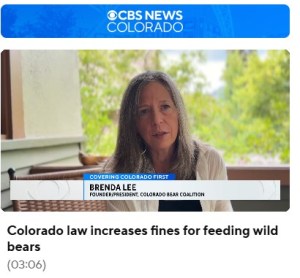
Excerpt from the interview:
When a bear finds food in a neighborhood, Lee said it can learn to return to the same area. That can ultimately put the animal at greater risk if its behavior creates a threat to people.
“We’re going to see more euthanizations of bears coming into urban landscapes because they’re hungry,” Lee said. “What we can do is scare them away. Let them know, ‘I’m really sorry, but you’re not welcome here.'”
Lee said bears that repeatedly get into trouble around people can eventually face euthanasia, making prevention especially important.
Lee said residents may be tempted to help hungry bears, particularly during a difficult year for natural food sources, but feeding them can create a larger problem.
“Let nature do what it’s meant to do,” Lee said. “As painful as it is to not do that, it’s important we don’t because we could end up causing a bigger problem.”
Additional context:
To clarify what Brenda meant by “Let nature do what it’s meant to do.”, this is referring to black bears’ adaptive remarkable adaptation called delayed implantation. A female bear mates in early summer, but the fertilized embryos don’t implant and begin developing right away. Instead, they wait in a kind of pause until she dens in late fall — and whether they implant at all, and how many, depends on her body condition at that moment. It’s nature’s built-in family planning: in a poor food year, her body produces fewer cubs (or none), keeping the population matched to what the land can actually feed.
Human food short-circuits this. A sow eating from trash, bird feeders, or intentional feeding enters her den in “great” condition, and her body responds by producing more cubs — cubs the drought-stressed landscape cannot support. Those cubs are then raised by a mother who teaches them to find food around people, which under CPW’s policies puts them on a path toward euthanization. So feeding doesn’t rescue bears from the drought; it creates more bears facing the same scarcity, with the added danger of habituation.
The most loving thing we can do is let that natural system work while making sure our neighborhoods don’t send false signals: securing trash, taking in bird feeders, and harvesting fruit trees.
Sierra Magazine article about BBC’s role in human-bear conflict

Boulder Bear Coalition, a video summary:

Boulder Bear Coalition is a proud member of the
Colorado Bear Coalition
a statewide nonprofit protecting black bears across Colorado
Boulder Bear Coalition is a non-profit, 501(c)(3) charitable organization.
EIN #: 46-3941088
 Boulder Bear Coalition
Hi Brenda Lee, I now giving monetary as well as volunteer (time and energy) support to the Boulder Bear Coalition. I want my cute bear thank you video now!!!
Keep up your good work, Katherine Webster
You need to extend the bear proof trash cans east of Broadway in Boulder.
And I suggested to the city back when we were required to get the bear proof trash cans that they need to plant appropriate bushes up in the foothills so the Bears have food and stay up there.
I don’t think that has happened.
But it seems like common sense.
Madelyn Wynne boulder